

Why Breathwork WORKS
The scientific explanation for the nerds and skeptics (saying this with love!)

This post is for you if:
You’ve heard about Breathwork, and it sounds kind of “woo.” Maybe a little too “out there” for your taste.
You don’t really know much about Breathwork, but at least a tiny little part of you is curious to learn more.
You’ve done talk therapy for awhile and are looking for a modality that takes a somatic approach to healing.
You’ve tried Breathwork before, but it was the kind where you were breathing really deeply the entire time.
You’ve tried Breathwork insofar as you’ve done it in yoga, but you haven’t done a dedicated Breathwork session.
Let’s begin with an important fact: not all breathwork is the same. There are loads and loads of different types of breathing patterns, each with their own purpose. The yogic tradition is a great place to start learning about these ancient techniques. Although I have trained in these types of breathwork, my real expertise is from my certification in Biodynamic Breathwork Trauma Release System (BBTRS), which uses a modern style of breathing called “conscious connected breathing” or “circular breathing.”
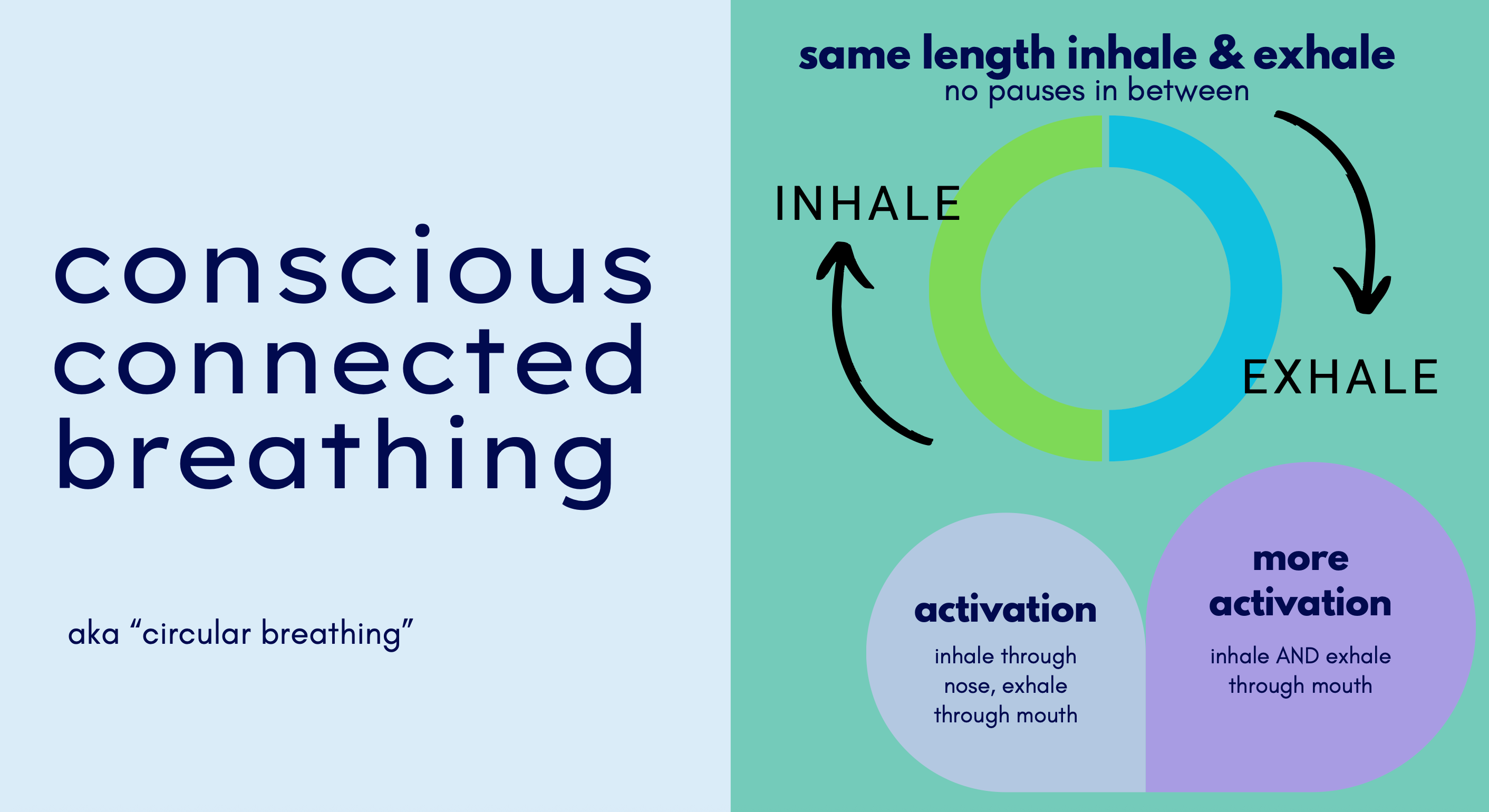
Briefly, conscious connected breathing is when your inhales and exhales are roughly the same length, and there is no pause or hold in between the inhales or exhales; as soon as you’re done inhaling, you exhale, and as soon as you’re done exhaling, you go right into the next inhale. It’s a continuous flow of breath in and out. Imagine the inhale as the first half of a circle and the exhale completing the circle:
Conscious connected breathing came out of the psychedelic movement. Once substances were banned, practitioners had to look for different ways to achieve the same kinds of effects: altered states of consciousness, connection with the divine, out of body experiences, etc. Before you get worried (or excited?) that that’s the work I’m offering, hold on: Conscious connected breathing only creates these states if you practice it for an hour (or more) at a time without breaks. Put differently, conscious connected breathing only creates these states if you override your body’s natural regulatory abilities.
We’re not designed to breathe like that for sustained periods of time, so when we go ALL IN for too long, it pushes us beyond what our bodies would naturally try to do to keep us in stasis or equilibrium. Yes, it can create very cool spiritual and psychedelic experiences, but it’s not going to help you in the material world.
Here is the juicy part. When conscious connected breathing is combined with periods of rest and body-based practices, the result is a powerful modality that can teach you how to be more comfortable in your body, broaden your ability to tolerate distress, and deepen your connection to yourself.
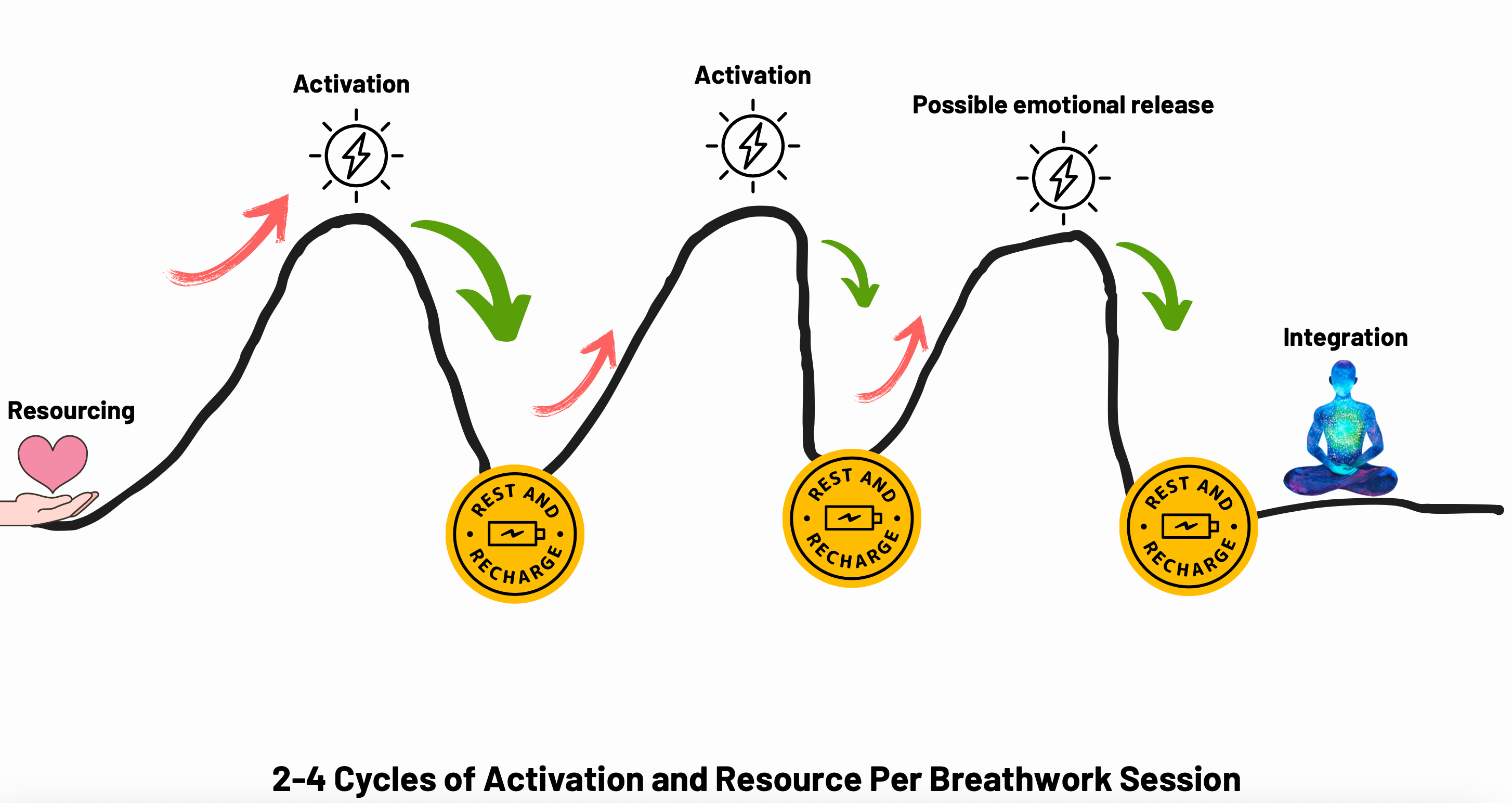
What do I mean by “periods of rest”? Somatic breathwork works in cycles, or phases. You spend several minutes doing conscious connected breathing, then slow back down again and rest in a more natural, calming breathing pattern. Then you start up the conscious connected breathing again for a second round, and then come back down. A typical session has 2-4 of these cycles of activation and rest. Check out this beautiful picture that I made of the flow of a typical session:
What do I mean by “body-based practices”? The breathwork I’m certified in (BBTRS) incorporates gentle movement, self-massage, and sound in order to keep you grounded in the present moment at all times—in your body—even while doing the conscious connected breathing. The goal of this type of breathwork is not to leave your body but rather to feel safer inhabiting your body, even in times of stress.
Practicing somatic breathwork eventually re-trains your nervous system in how to respond to stressful events in the real world. Here’s why:
When you engage in conscious connected breathing, it activates your sympathetic nervous system: your fight/flight response. You learn what it feels like in your body to get activated, and you become very well-acquainted with the sensations that accompany it, like tension in different muscle groups, tingling in your limbs, or tightness in your chest. (We all experience activation a little bit differently, and you get to really understand what it’s like for YOU.)
THEN, when you purposefully slow your breathing down again during the periods of rest, you activate your parasympathetic nervous system: your rest and digest response. Essentially, you’re demonstrating to your nervous system that you’re capable of regulating after overwhelming events.
You’re giving your system the experience of what it’s like to feel safe again after stress.
If you’ve spent most of your life in a state of dysregulation, having this physical experience of stress-followed-by-safety is a way to re-train your nervous system in what is possible: We can do this. We know how to regulate. After enough practice, when you get overwhelmed in your day-to-day life, your body will remember how to regulate again.
I cannot overstate how powerful this is. The sense of freedom that accompanies being able to trust your body is unparalleled.
So far, I’ve explained how breathwork affects your nervous system state, and I’ve touched a little bit on how it changes your physiological state. But it goes a lot deeper than tense muscles and tingling sensations. I promised you some science, so here we go. I’m going to channel Miss Frizzle from The Magic School Bus. *throat clear*
Let’s take a dive into your bloodstream, students! When you breathe in more oxygen than your body requires, which is what happens when you engage in conscious connected breathing (or exercising), more CO2 is released out of the body on your exhales than normal. When CO2 levels are lowered in your blood, your blood vessels constrict, which is why you may experience tingling and sometimes dizziness. When you continue over-breathing, the blood flow changes in your brain as well. More specifically, blood flow to the frontal lobe and hippocampus is reduced, which impacts memory, how time is experienced, and the idea of the self. In short, the reduced function of these parts of your brain quiets your inner chatter. Sometimes people with ADHD report feeling “blissfully without thoughts” during breathwork sessions.
Once you stop exhaling too much CO2, your body returns to equilibrium. This is why breathwork that uses conscious connected breathing with periods of rest is so powerful: you get to experience the soothing effects of your mind quieting down without going SO FAR that you experience depersonalization and dissociation. It’s the best of both worlds. Are you still reading this in Miss Frizzle’s voice? It’s me again.
The last thing I’ll say is that breathwork changes your emotional state in addition to your nervous system and physiological states. But that’s a topic for another post.
Did you learn anything new? If so, it would mean the world to me if you subscribed (if you haven’t already) and shared this post with a friend.
Want to work with me? Here are a few ways I can help you:
1.Join a queer community breathwork session (virtual, allies also welcome): Meets the first Wednesday of every month, 6:00-7:15 pm (US-Eastern Time). More info here.
2. Work with me 1:1 (virtual): This is for you if you’re looking for a more personalized approach to deepen and accelerate your healing process. Fill out my application form to see if we’d be a good fit.
3.NEW - UPDATE: Watch my upcoming video series on how to regulate your nervous system and find strategies that actually work for you that you can start using daily. Upgrade to a paid subscription to access the videos as they come out.
I loved the Miss Frizzle riff (and all the cool science). Such good stuff. Thank you, Rey. 🙏